- Product

- Pricing
- Affiliate Program
- Developers
- Resource
 EN
EN
CAPTCHA-solving services (anti-CAPTCHA services) are used in task automation scenarios where it is impractical to manually click images or type CAPTCHA text. They take an image or CAPTCHA parameters as input and return a solved answer. In this article, we will look at the following services: 2Captcha, SolveCaptcha, Anti-Captcha, CapMonster Cloud, TrueCaptcha, and DeathByCaptcha. We will compare them by solving speed and accuracy, pricing, APIs, and supported CAPTCHA types.

2Captcha is one of the oldest and largest services (operating for more than 10 years). It is almost entirely based on manual solving: a large network of human workers handles different types of CAPTCHAs. This provides maximum accuracy (any CAPTCHA can be solved by a human) but introduces variable delays. Simple text CAPTCHAs are solved in 7–15 seconds, while more complex ones (for example, Google reCAPTCHA v2) take on average 10–20 seconds (in rare cases processing can take up to ~60 seconds). Thanks to hundreds of simultaneously active workers, 2Captcha handles parallel requests well without strict limits.
CAPTCHA support: maximal – the service supports all variants of Google reCAPTCHA (v2, Invisible, v3, Enterprise), hCaptcha, FunCaptcha (Arkose), GeeTest, as well as regional systems (Yandex, VK, etc.). In addition, it provides solutions for “image CAPTCHAs”, “click CAPTCHAs”, and other non-trivial tasks.
API and integration: a simple HTTP API with two calls (submit/get). There are ready-made SDKs for Python, PHP, Java, C#, JS and more (you just install the library and call a single method). 2Captcha officially provides browser extensions (Chrome/Firefox/Opera).
Pricing: from $0.50 per 1,000 simple CAPTCHAs; Google reCAPTCHA v2 is usually $1–3 per 1,000. Prices are dynamic: during peak periods the rate may increase. For incorrectly solved CAPTCHAs, the service issues refunds. There is no free trial, but you can run small tests with minimal deposits, and an API key gives you immediate access.
Pros: reliable and universal (solves almost any CAPTCHA), widely known, and cheap for most tasks. Russian-language support. Cons: delays due to manual solving (compared to pure AI services, solutions may be slower); no free trial.
SolveCaptcha is a relatively new “hybrid” service combining neural networks and human workers. Simple CAPTCHAs (plain text on images) are first attempted by the algorithm, taking about 2–5 seconds. If the model is not confident (for example, with multi-component reCAPTCHA or heavily distorted CAPTCHAs), the task is immediately handed off to a human. As a result, SolveCaptcha successfully solves 95–99% of all popular CAPTCHAs at record speed.
Speed: it really leads in fast solving: simple images take ~3–5 seconds, typical reCAPTCHA v2 around 13 seconds on average. Even complex CAPTCHAs (multi-level reCAPTCHA, FunCaptcha) are solved faster than by many competitors (on average 10–20 seconds). According to an independent benchmark by captchathecat, reCAPTCHA v2 is solved in about 4–5 seconds. SolveCaptcha can handle up to ~11–12 thousand requests per minute for simple CAPTCHAs thanks to a large cluster.
Accuracy: high – 95–99%, with rare errors. If a solution is incorrect, the service allows resubmitting the CAPTCHA free of charge (as 2Captcha does). With its AI+human approach, SolveCaptcha manages to combine speed and reliability.
CAPTCHA support: similar to 2Captcha – the service covers all versions of Google reCAPTCHA (v2/v3/Invisible/Enterprise), hCaptcha, Arkose FunCaptcha, Cloudflare Turnstile, GeeTest, and other popular systems. New types are integrated quickly (if the network cannot cope, a human is brought in). Limitations: it does not handle only ultra-exotic tasks (specialized, highly regional, non-standard CAPTCHAs).
API and integration: SolveCaptcha fully emulates the 2Captcha API (tested against in.php/res.php), so migration from 2Captcha to SolveCaptcha is very straightforward. There are official SDKs for ~8 languages (including Python and JS), webhooks, and extensive documentation. Chrome/Firefox extensions are supported.
Pricing: lower than most human-based CAPTCHA-solving services. Simple CAPTCHA – about $0.50 per 1,000. Google reCAPTCHA v2 – about $0.55, v3 – about $0.80, Arkose FunCaptcha – up to about $2.99. Prices are fixed. SolveCaptcha is “fast and cheap” – cost-effective for large volumes when high speed is needed.
Pros: maximal speed at solid accuracy; easy integration (2Captcha-compatible API); reasonable prices. Suitable for large projects where time is critical. Cons: a newer system – less accumulated track record, occasional outages (like any cloud solution); not the largest pool of human workers (if you need 100% accuracy on the most difficult CAPTCHAs, 2Captcha can sometimes be a better choice).

Anti-Captcha (AntiGate) is a direct alternative to 2Captcha. Its main method is human workers (no AI), so it effectively covers the same tasks as 2Captcha.
Speed: thanks to optimized infrastructure, the average solving time for simple tasks is ~5–10 seconds. Complex reCAPTCHA challenges are usually solved in 10–20 seconds (during peaks it can reach 30 seconds). It is competitive with 2Captcha in terms of speed profile (responds quickly under normal load). Parallel performance is one of the service’s strong points.
Accuracy: on par with 2Captcha – most CAPTCHAs are solved with about 99% accuracy.
CAPTCHA support: full. The service solves all variants of Google reCAPTCHA (including Enterprise), hCaptcha, GeeTest, FunCaptcha, Cloudflare Turnstile, and others. Like 2Captcha, Anti-Captcha adds support for new CAPTCHA types very quickly as they appear.
API and integration: JSON-RPC API (createTask/getTaskResult methods), a bit more complex than 2Captcha’s but more flexible: you can specify proxies, browser emulation type, priority, etc. There are official SDKs in many languages, ready-made modules for Selenium/Puppeteer/iMacros. Extensions exist for Chrome/Firefox/Safari. It supports payment via card, SMS, cryptocurrency. Support is 24/7 (although the quality of support is somewhat lacking).
Pricing: similar to 2Captcha: about $0.50 per 1,000 simple CAPTCHAs, about $1–2 per 1,000 reCAPTCHA/hCaptcha. Subscription packages are available for large volumes. Refunds for errors are generally not offered.
Pros: flexible API, high scalability, support for complex scenarios. Cons: no free testing; the API requires slightly more configuration (JSON instead of a very simple HTTP call); the interface can feel “old-school”.

DeathByCaptcha is an international service with over 15 years of history and one of the first to introduce a hybrid model. It combines its own OCR+AI with human workers: simple text CAPTCHAs are first attempted by the bot, achieving around 90% accuracy immediately, and if confidence is low, the task is forwarded to a human so the final accuracy reaches 99%.
Speed: text CAPTCHAs are solved quickly thanks to OCR – about 9 seconds. Complex CAPTCHAs (for example, reCAPTCHA) are handled by humans, so the average is 15–30 seconds. In practice, solutions tend to come closer to 15 seconds, but during peak periods they can stretch to 30+ seconds. Scalability is average: hundreds of parallel requests are fine, but at thousands there may be delays or price increases.
Accuracy: very high thanks to human involvement – around 99%. The automated bot solves about 90% of simple CAPTCHAs on the first try.
CAPTCHA support: broad. DBC originally focused on text CAPTCHAs but expanded its list: all types of reCAPTCHA v2/v3 (including Invisible), hCaptcha, Arkose FunCaptcha, GeeTest and many exotic types (KeyCaptcha, Lemin, Capy Puzzle, AWS WAF CAPTCHA, FriendlyCaptcha, etc.).
API and integration: a simple 2-call scheme compatible with 2Captcha and Anti-Captcha APIs. DeathByCaptcha ships its own library for Python (available on PyPI) and clients for Java, C#, etc. If needed, you can send requests in the same format as Anti-Captcha (compatibility mode). There are official Chrome/Firefox extensions. Support is English-only; the documentation is clear.
Pricing: slightly above average. Simple CAPTCHAs – about $0.99 per 1,000 (sometimes promotional $0.90); complex ones – several dollars per 1,000 (depending on type). During peak load, prices can rise by 10–20%. Money is refunded for incorrect solutions. There is no free trial, but you can test with a small paid batch.
Pros: the hybrid model provides good speed and high accuracy; support for audio CAPTCHAs; free libraries. A solid secondary/backup provider. Cons: more expensive than many competitors for complex CAPTCHAs; less popular in the Russian-speaking segment (slower Russian support).

CapMonster Cloud is a fully AI-based service, evolved from the offline CapMonster solver by ZennoLab. Its main advantages are ultra-fast solving and low cost: no human workers, only machine algorithms.
Speed: record-breaking. Under ideal conditions, the service handles up to 1,000 CAPTCHAs per minute (<1 second per CAPTCHA). In practice, Google reCAPTCHA and Turnstile are solved in about 1–3 seconds, simple text CAPTCHAs almost instantly (under a second). This makes CapMonster one of the best options for high-volume automation: latency is minimal.
Accuracy: very high for supported types (up to 99% for simple reCAPTCHA), but drops on rare or exotic tasks. CapMonster cannot reliably solve very complex interactive CAPTCHAs (for example, modern FunCaptcha/Arkose 3D puzzles). For those, effectiveness is much lower or they are simply unsupported.
CAPTCHA support: includes the most common ones: all Google reCAPTCHA v2/v3 (including Invisible/Enterprise), hCaptcha (including Enterprise), GeeTest, Cloudflare Bot/Turnstile, standard image CAPTCHAs, as well as DataDome, Tencent, etc. It skips fully interactive multi-step tasks (Arkose FunCaptcha is still “not fully handled”).
API and integration: the key feature is full compatibility with 2Captcha/Anti-Captcha APIs: you can send the same requests to different URLs. There is also its own API endpoint with a similar structure. Proxy handling is built in (“out of the box” – the service chooses proxies itself when needed). It offers Chrome/Firefox extensions and ready-made libraries (including Python). The documentation is available and straightforward.
Pricing: significantly lower than “human” services. The simplest CAPTCHAs – about $0.02–0.04 per 1,000 (0.02–0.05 rubles per CAPTCHA), reCAPTCHA v2 – about $0.5–2 per 1,000 (₽50–194). You only pay for successfully solved CAPTCHAs.
Pros: minimal latency, excellent throughput, low price – the best choice for large-scale workloads. Cons: no support for complex CAPTCHAs like FunCaptcha, etc.; accuracy may drop on non-standard tasks.

TrueCaptcha is a fairly new service that specializes in fast solving of classic CAPTCHAs without complex interactive elements. It focuses on automated OCR and can optionally involve manual solving.
Speed: very fast for its target tasks – responses arrive in under 5 seconds. Since it covers only a limited set of CAPTCHAs, the service is always tuned for speed.
Accuracy: automatic solving achieves >90% success rate; with human involvement, accuracy approaches 100%. Like SolveCaptcha, the service uses a “hybrid system”: it first attempts OCR, and brings in a human when errors occur.
CAPTCHA support: limited to simple images and basic types: Google reCAPTCHA v2/v3, hCaptcha, FunCaptcha, etc., but only as images. That is, TrueCaptcha can solve string-based image CAPTCHAs (“enter the letters from the picture”) and some web CAPTCHAs, but it is not designed for tasks like “click on the correct image” or complex audio puzzles. It is suitable for normal text CAPTCHAs.
API and integration: it has a simple HTTP API. It supports two modes (standard image2text and callback). Browser extensions are available for Chrome/Firefox. It works with Python (via an official SDK or simple HTTP requests). A free demo account with ~30 CAPTCHAs lets you test speed and accuracy at a small scale.
Pricing: very low – $0.33 per 1,000 simple CAPTCHAs. This makes TrueCaptcha one of the cheapest options, but the price applies only to standard text CAPTCHAs.
Pros: excellent speed and low price for simple tasks, free testing. Cons: narrow specialization (no complex or audio CAPTCHAs), limited market experience. Best suited when you need cheap and fast solving of basic text CAPTCHAs.
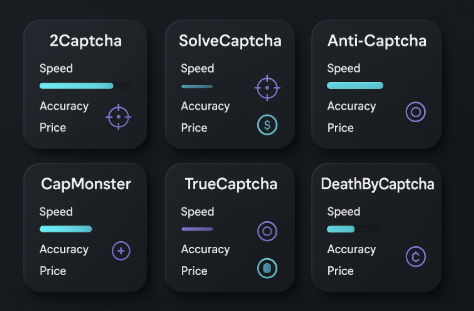
For clarity, let’s summarize the key parameters in tables.
The table shows: AI-driven services (SolveCaptcha, CapMonster) provide the lowest response times, while human-based ones (2Captcha, Anti-Captcha, DBC) are slightly slower but often more reliable for very complex CAPTCHAs. In terms of price, CapMonster leads; the others charge up to ~$1–3 for labor-intensive CAPTCHAs. TrueCaptcha is the price winner for very simple use cases.
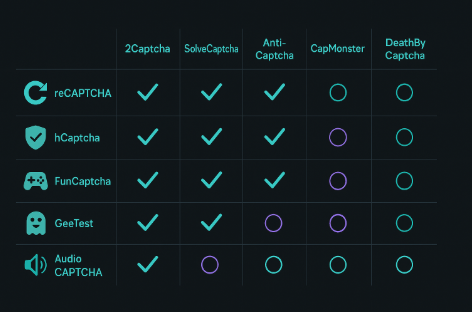
A summary table of the main CAPTCHA types supported by the services:
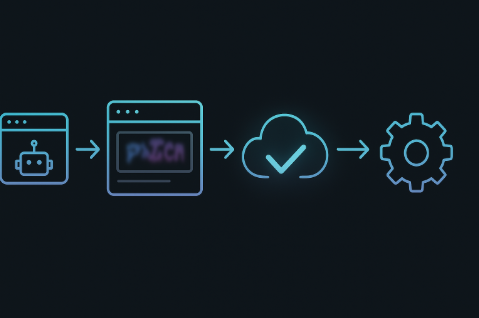
All the services mentioned have open HTTP APIs for automation. As a rule, one request is used to submit a task (upload the CAPTCHA/parameters), and a second to retrieve the result (polling or callback).
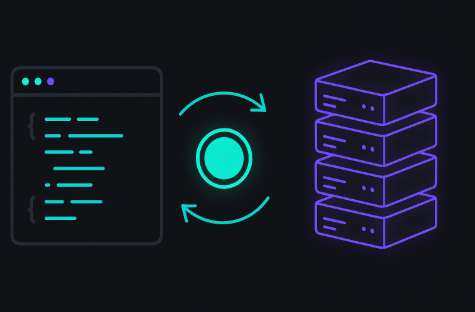
2Captcha/SolveCaptcha: the simplest two-step API (submit/get). 2Captcha offers official libraries, including for Python (2captcha-python), which simplifies development. SolveCaptcha is API-compatible with 2Captcha, so migrating from 2Captcha usually just means changing the base URL. Python SDKs are available, as well as examples using requests.
Anti-Captcha: JSON-RPC API (createTask/getTaskResult methods). It allows fine-grained request tuning (proxies, extra options). There are official SDKs (including anticaptchaofficial for Python), ready-made plugins for Selenium/Puppeteer, and code samples. Arbitrary custom tasks are supported through the API (for advanced scenarios).
DeathByCaptcha: supports HTTP and socket APIs. Its API method is compatible with the 2Captcha/Anti-Captcha format, which makes integration easier. The official Python library deathbycaptcha (on PyPI) lets you submit a CAPTCHA and get a response in a single call. Clients are also available for Java, C#, etc.
CapMonster Cloud: lets you use familiar 2Captcha/Anti-Captcha formats (you can send tasks with the same structure). Its own API is very similar, so integrators do not need to learn a new schema. Libraries exist for all popular languages. In Python code, it is often enough to change the endpoint URL and the client will work. Proxies are provided automatically.
TrueCaptcha: offers a straightforward REST API: a POST form with an image or URL and result retrieval via webhook or polling. There is sample Python code in the docs, as well as Chrome/Firefox extensions: right-click and “Solve captcha”. The service is aimed at quick DIY CAPTCHA solving from a browser or script.
In practice, working with any of these APIs boils down to requests.post(...) with a key and payload, followed by waiting for a response with a token. For all services, the algorithm is similar: upload CAPTCHA → receive captcha_id → wait for the result (usually 10–20 seconds) and get the solved text. Thanks to ready-made libraries (pip install <package_name>), setting up Python integration can be done without coding everything “from scratch”.
Parallelism: Anti-Captcha allows effectively unlimited parallel requests (rarely restricted). SolveCaptcha claims very high limits (up to ~12,000 requests per minute for some types). CapMonster can process thousands of CAPTCHAs per minute. 2Captcha also scales well thanks to its large worker pool. DeathByCaptcha may raise prices when traffic spikes sharply, but generally maintains fast response times.
Proxies: With 2Captcha and Anti-Captcha you can set your own proxy servers for requests (to anonymize client sessions). CapMonster Cloud automatically uses built-in proxies so that challenges are submitted from diverse IPs. This is convenient for large-scale scraping of difficult sites. SolveCaptcha and TrueCaptcha typically do not require additional proxies (the solving happens on the solver side).
Localization: For Russian-speaking users, 2Captcha is attractive due to support for rare CIS CAPTCHAs (Yandex, Mail.ru, VK) and Russian-speaking workers. DeathByCaptcha is historically more known in Western markets. SolveCaptcha and CapMonster are international products; their interfaces are in English but localized enough for Russian users. TrueCaptcha is English-only, but its pricing is fixed, which can be advantageous.
Security: All mainstream services use HTTPS and token-based authentication, but you should keep libraries up to date.
Let’s sum up. All the services reviewed provide solid algorithms for solving most CAPTCHAs via open APIs. The choice depends on your requirements:
2Captcha: a battle-tested solution. Universal (with support for almost all popular and exotic CAPTCHAs) and relatively inexpensive. Best used when you need broad coverage and can tolerate delays of tens of seconds. Strong points: cross-platform ecosystem and Russian-speaking environment.
SolveCaptcha: the optimal choice when you need speed. Its hybrid approach makes it very fast on common tasks (reCAPTCHA, hCaptcha) at a reasonable price. Suitable for projects where CAPTCHAs are solved by the thousands and latency matters.
Anti-Captcha: focused on load and flexibility, good for corporate use cases where you need reliability and unlimited parallelism.
CapMonster Cloud: ideal for large-scale automation. The cheapest in this list (saves 5–10× on big volumes) and extremely fast. You trade some support for cutting-edge CAPTCHAs (Arkose/FunCaptcha) for speed and price. It’s wise to have a fallback path: if CapMonster’s neural network cannot solve a CAPTCHA, you can switch to a secondary service (for example, SolveCaptcha).
TrueCaptcha: essentially a niche tool. It is used when you need to solve simple text CAPTCHAs very cheaply. The service is cost-efficient and simple, but limited in functionality (no interactive or audio CAPTCHAs). Recommended as a “fast filter” for ordinary CAPTCHAs before sending the task to a more powerful service.
DeathByCaptcha: a strong backup option. It can solve almost any CAPTCHA (including audio) with quality guarantees. It is used when other services fail. Often combined with a primary solver to increase overall reliability.
The optimal scheme is to combine services. For example, use CapMonster or SolveCaptcha for fast solving, and if they fail – switch to 2Captcha/Anti-Captcha/DBC. All providers offer some kind of free or low-cost testing (trial balances or demos), so before committing to a plan you should run a test script and measure actual speed and accuracy.
The right choice depends on your use case: volumes, required speed, budget, and necessary CAPTCHA types. Hopefully, this review will help you decide which anti-CAPTCHA service is the best fit for your particular project.

 EN
EN

.png)